Friday, 6 February 2015

Apple looking to help cut the cord with web-based TV bundle service

Apple looking to help cut the cord with web-based TV bundle service


TV screen

With an abundance of cheap, easy-to-use media streamers flooding store shelves and a plethora of services flooding the digital marketplace, it may seem like it’s too late for any company to get in on the game and carve out its own share of the market — unless that company has enough influence to change a market all on its own. Recent reports suggest that Apple is looking to make its own streaming TV service, and with an influence as wide as Apple’s, the market could dramatically shift should that plan come to fruition.
One of the longest-running (and ongoing) Apple rumors is that the company has been planning to make a television, and considering its attention to detail and aesthetics, that has always been a juicy prospect. Instead, the company made a media streamer, the Apple TV, and named it after what would almost certainly be the name of its mythical television. Now, it seems, if Apple doesn’t want to get into TV hardware, it will at least get into TV services. Industry insiders are reporting that Apple is exploring deals with TV programmers that would allow the company to offer programming bundles that customers could pick and choose.
Apple TV
Rather than offer everything available through traditional cable services, Apple would bundle together certain packages and sell them on its own streaming service. Unless you’re very lucky with your viewing habits, the bundles won’t offer everything you want to watch, and thus won’t spark a cord-cutting revolution, but the breadth of the bundles could at least soften the blow of dumping your cable package. It could very easily offer “live” programming as well, considering competitors — such as Dish with its Sling TV — have managed to strike similar deals.
The Apple TV is simply a device that delivers other companies’ services and content; these reports don’t mention anything of Apple attempting to create its own content. If Apple does manage to get people paying for its own offering of television programming and those customers are watching it over Apple’s own hardware delivery mechanism, it would be remiss to think Apple wouldn’t want to further conquer the market by then getting customers to watch its own original content. Sony is already giving it a go with PlayStation Vue, Netflix proved original non-cable content can garner acclaim, and Apple is arguably an even bigger mover and shaker than either.
For now, these reports are just that — reports. However, if Apple is actively discussing plans with content creators and providers, then that at least means the company is seeing if the venture would be worthwhile. If so, why would Apple not do something worth doing?

ET deals: Save $150 (29092.50 Nigerian Naira) on a HP Envy 15t laptop

ET deals: Save $150 (29092.50 Nigerian Naira)  on a HP Envy 15t laptop


HP Envy 15t

Laptops have been getting smaller, lighter, and more focused on casual computing. There’s nothing inherently wrong with that trend, but these tiny low-power machines aren’t a proper fit for everyone. Some of us need more powerful machines to get work done, and so netbooks and Ultrabooks aren’t even on the table. Thankfully, we found a deal at HP for $150 off of a 15-inch laptop with a quad-core CPU and dedicated graphics — no need to pay retail for a laptop with some real muscle.
HP Envy 15t (Small)
So, what is this portable powerhouse packing? The HP Envy 15t has a quad-core 2.3GHz Intel Core i7 CPU, dedicated Nvidia GeForce GTX 850M graphics, 8GB of DDR3L RAM, a 750GB 5400RPM hard drive, and 802.11b/g/n WiFi support. Paired with a 15.6-inch 1080p display and a very respectable 6-cell 47WHr lithium-ion battery, it’s easy to see why this is a perfect fit for engineers, designers, and other professionals on a budget.

Normally, this configuration sells for $899.99, but you can save $150 off that price if you use our promo code “15HPLOGICBUY” in your shopping cart. That takes the price down to $749.99 — over 16% off of the initial asking price. Frankly, this is an excellent compromise between price and performance. You could spend $200 on a Chromebook or $2000 for a MacBook Pro, but this is really the sweet spot for your average professional.

ET deals: Dell Optiplex 3020 Micro desktop PC for $329

ET deals: Dell Optiplex 3020 Micro desktop PC for $329  ----- #63,809.55k Nigerian Naira

OptiPlex 3020 Micro

If you’re tired of keeping around a loud, bulky PC on your desk, take a look at the OptiPlex 3020 Micro from Dell. This tiny machine might not look like much, but it’s more than enough computer for everyday tasks like web browsing and e-mail. Even better, it’s incredibly affordable, so it makes for a perfect office PC.
OptiPlex 3020 Micro
Currently, there are two stand-out configurations worth mentioning here. First off, let’s talk about the cheaper dual-core model. It sports a 3.0 GHz Intel Core i3 CPU, integrated Intel HD 4400 graphics, 4GB of DDR3 RAM, and a 500GB 7200RPM hard drive. Secondly, we have the beefier quad-core model. Inside of it is a 2.0GHz Intel Core i5 CPU, integrated Intel HD 4600 graphics, 4GB of DDR3 RAM, and a 500GB 7200RPM hard drive. They’re mostly identical, but clearly the CPU and GPU are superior in the quad-core configuration.

The starting price for the dual-core Optiplex 3020 micro is $612.86, but Dell currently has it on sale $569. If you apply the coupon code “SHBGD1LVLCD199” in your cart, your subtotal will drop to just $329. Similarly, that very same coupon code will drop the quad-core model down to $469. Whichever config matches your needs, you’ll end up with an awesome tiny PC.
Check out these other outstanding deals:
Today, we found a fantastic bargain on two Dell monitors as well. Both models feature IPS LED-lit displays with a full 1080p resolution. Even better, they both come with $100 eGift cards — just use coupon code “7ZB7SD?2L3CWV2” for the best price.

Did chip espionage, IP theft give Samsung its 14nm manufacturing lead?

Did chip espionage, IP theft give Samsung its 14nm manufacturing lead?


Samsung S2 foundry

For most of the past decade, the semiconductor industry has been led by the same pair of companies: Intel was the most-advanced integrated device manufacturer (IDM) and led the entire market, while TSMC was the most advanced contract manufacturer (sometimes called a pure-play foundry). Samsung’s leapfrog over TSMC to become the 14nm provider of choice. A recent article has argued that Samsung’s sudden change in fortunes was no fortuitous accident, but the result of sniping several critical TSMC employees. One man in particular is alleged to have boosted Samsung’s efforts — Liang Mong-song.
TSMC first sued Liang back in 2011, alleging that the chip designer had given trade secrets to Samsung and broken his non-compete agreement. As evidence, the company submitted a lengthy report it commissioned from outside experts which compared various features of TSMC products against the manufacturing characteristics of their Samsung counterparts. As Samsung moved to lower process nodes, TSMC argued that its products began to increasingly resemble TSMC’s own hardware. According to TSMC’s engineers, the two foundries’ now have nearly identical 14/16nm process nodes.

China to have most robots in world by 2017: IFR

China to have most robots in world by 2017: IFR


China will have more robots operating in its production plants by 2017 than any other country as it cranks up automation of its car and electronics factories, the International Federation of Robotics (IFR) said on Thursday. 


Already the biggest market in the $9.5 billion global robot trade -- or $29 billion including associated software, peripherals and systems engineering -- China lags far behind its more industrialized peers in terms of robot density. 

China has just 30 robots per 10,000 workers employed in manufacturing industries, compared with 437 in South Korea, 323 in Japan, 282 in Germany and 152 in the United States. 

But a race by carmakers to build plants in China along with wage inflation that has eroded the competitiveness of Chinese labour will push the operational stock of industrial robots to more than double to 428,000 by 2017, the IFR estimates. 

"Companies are forced to invest ever more in robots to be more productive and raise quality," said Gudrun Litzenberger, general secretary of the Frankfurt-based IFR. 

"In the current phase it's the auto industry, but in the next two or three years it will be driven by the electronics industry," she said. 

Japanese robot makers still have the lion's share of the market, with about 60 percent, but Chinese suppliers are growing fast, with about a quarter of the market. Most of the rest are supplied by European and US manufacturers. 

Four foreign robot makers -- Switzerland's ABB, Germany's Kuka, and Japan's Yaskawa and Fanuc -- already have production sites in China and more are expected to follow. 

"The automation of China's production plants has just started," said Per Vegard Nerseth, Managing Director of ABB Robotics. "We have witnessed swift, almost explosive growth over the last two or three years, surpassing even our expectations." 

The automotive industry is by far the largest customer for robots in China, accounting for about 40 percent of robots in operation, as China is both the world's biggest car market and its biggest production site. 

European carmakers such as Volkswagen and Daimler which have invested heavily in China are bringing their robotics suppliers with them, Litzenberger said. 

The electronics industry is expected to follow. 

Taiwanese contract manufacturing giant Foxconn, which makes Apple iPhones and iPads among other products, is already making its own Foxbot robots as well as using robots bought from other suppliers.

Tuesday, 3 February 2015

BMW fixes security flaw that left locks open to hackers

BMW fixes security flaw that left locks open to hackers

BMW  


BMW has patched a security flaw that left 2.2 million cars, including Rolls Royce and Mini models, open to hackers.
The flaw affected models fitted with BMW's ConnectedDrive software, which uses an on-board Sim card.

The software operated door locks, air conditioning and traffic updates but no driving firmware such as brakes or steering, BMW said.

No cars have actually been hacked, but the flaw was identified by German motorist association ADAC.

ADAC's researchers found the cars would try to communicate via a spoofed phone network, leaving potential hackers able to control anything activated by the Sim.

The patch, which would be applied automatically, included making data from the car encrypted via HTTPS (HyperText Transfer Protocol Secure) - the same security commonly used for online banking, BMW said.

"On the one hand, data are encrypted with the HTTPS protocol, and on the other hand, the identity of the BMW Group server is checked by the vehicle before data are transmitted over the mobile phone network," it said in a statement.
This should have already been in place, said security expert Graham Cluley.

Hey, Gmail me that cash you owe

Hey, Gmail me that cash you owe

Gmail payments are coming 

It's the social situation we all try to avoid; forgetting to pay someone back because we don't have any cash, or that card reader thingie, to do it online.

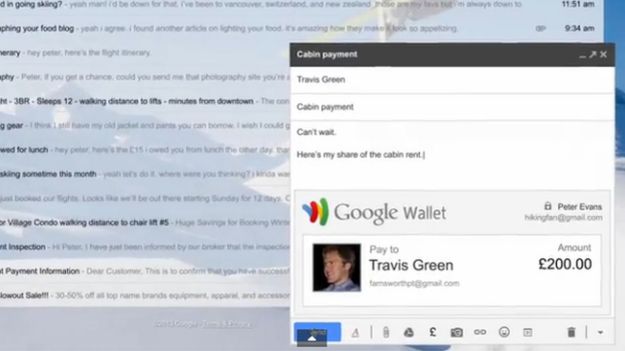
Well Google are having a go at making debt settling easier, by allowing users to transfer funds on email.
It's coming in over the next few weeks for all Gmail users who are over 18 in the UK. 

Users will have to click the "£" icon which will soon appear on emails, and enter the amount they wish to send.
Google page 


Google made the announcement on an official blog post and says the service will be free. 

If you're really desperate for that score to be settled, you can even send requests for how much money you'd like to receive.

Users without a Gmail account will also be able to be sent cash - everyone will have to set up a Google wallet balance, and link it to their debit card or bank account.